
By Dr. Sneedha Mainali, MDS · Shine Dental Clinic, Sanepa, Lalitpur · Last Updated: June 2026 · 15-min read
You are staring at your baby’s gums, waiting for that first little tooth to appear. Or maybe it already has, and you are suddenly wondering: How do I clean this? When should I book a pediatric dentist? Is fluoride toothpaste safe? What if a tooth comes in crooked?
If those questions feel overwhelming, you are in exactly the right place.
This guide covers everything parents need to know about baby teeth from the moment your baby is born through to their first permanent tooth around age six. It is written in plain language, backed by research from the world’s leading paediatric dental bodies, and built on the clinical experience of our team at The Shine Dental Clinic in Sanepa, Lalitpur.
Quick Answer: Start cleaning your baby’s gumpads(where the future teeth will erupt) from birth with a damp cloth. Begin brushing with a soft infant brush and a rice-grain-sized smear of fluoride toothpaste the moment the first tooth appears. Book the first dental visit by 12 months. That is the short version. Everything else is below.
Table of Contents
Why Baby Teeth Matter More Than Most Parents Realise
There is a belief we hear often at The Shine Dental Clinic: ‘They are just milk teeth. They fall out anyway.’ It is understandable. But it is one of the most costly misconceptions regarding children’s health and wellbeing.
Baby teeth also called primary teeth, milk teeth, or deciduous teeth are not placeholders waiting to be replaced. They are active, functional, developmental tools your child depends on every single day from the moment they erupt.
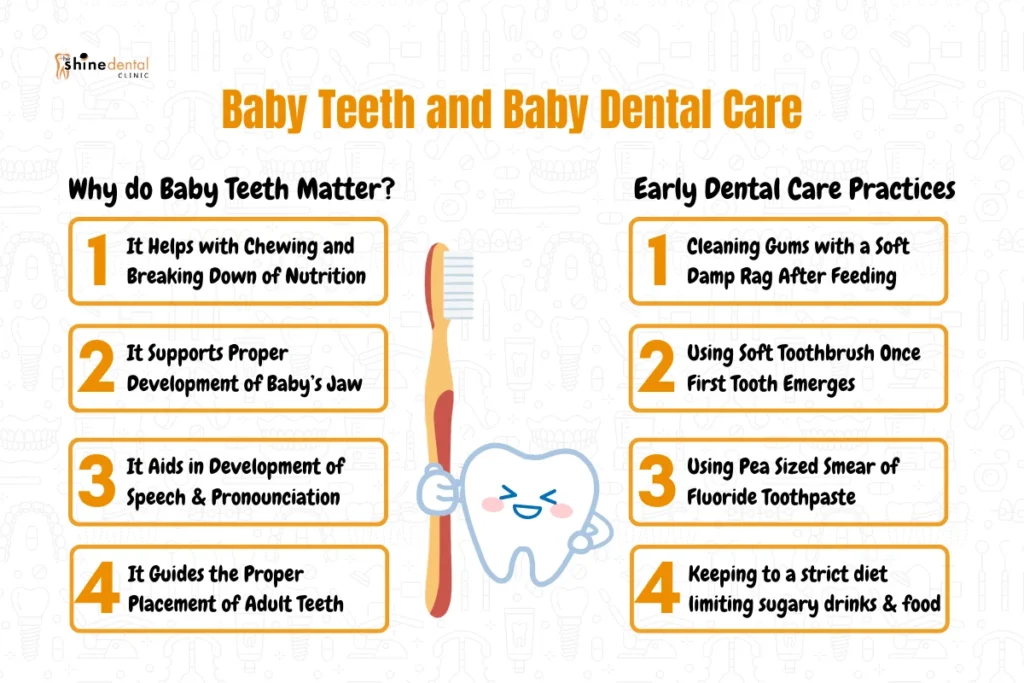
What Baby Teeth Actually Do
- Chewing and nutrition: Baby teeth allow children to transition from milk to solid foods. Without them, children cannot bite, grind, or chew adequately which directly restricts diet and limits nutritional variety. A painful tooth restricts all and impacts growth.
- Speech development: Teeth work directly with the tongue and lips to form sounds. Front teeth are essential for sounds like ‘th’, ‘s’, ‘f’, and ‘v’. Children who lose front baby teeth early due to decay often develop speech difficulties that require intervention.
- Space holding for permanent teeth: Each primary tooth holds a precise space in the jawbone for the permanent tooth that will follow. When a baby tooth is lost early to decay, infection, or extraction neighbouring teeth drift into the gap within weeks. The permanent tooth then erupts into insufficient space, often emerging crooked or crowded. Correcting this orthodontically can take years and significant cost.
- Jaw and bone development: The physical act of chewing with baby teeth stimulates proper growth and development of the jawbone. Healthy primary teeth support the structural development of the entire lower face.
- Self-confidence: Even very young children notice their smiles. Visible decay, discolouration, or missing front teeth affects how children feel about themselves in daycare, school, and social settings.
- Protection for permanent teeth: Each permanent tooth develops directly beneath its baby tooth predecessor inside the jawbone. An infection or abscess in a baby tooth can damage the developing permanent tooth bud causing discolouration, enamel defects, or malformation that lasts a lifetime.
According to the World Health Organisation, Early Childhood Caries (ECC) affects up to 60% of children in some populations and is classified as one of the most prevalent chronic childhood diseases globally. It is almost entirely preventable.
Baby Teeth Eruption Timeline: When Each Tooth Appears
Your baby is born with all 20 primary teeth already formed beneath the gums, simply waiting for the signal to emerge. The full eruption process typically spans from around 6 months to age 3, though wide and completely normal variation exists between children.
The Eruption Sequence
Teeth generally erupt symmetrically the left and right of each type emerge at roughly the same time. Lower teeth typically precede upper teeth.
| Tooth Type | Upper Jaw | Lower Jaw |
| Central incisors (front two teeth) | 8–12 months | 6–10 months |
| Lateral incisors (either side of front) | 9–13 months | 7–16 months |
| Canines (eyeteeth) | 16–22 months | 16–23 months |
| First molars (back grinding teeth) | 13–19 months | 12–18 months |
| Second molars | 25–33 months | 20–31 months |
Source: American Academy of Pediatric Dentistry Primary Tooth Eruption Chart. Individual timing may vary.
What Normal Teething Variation Looks Like
The ranges above are wide because real variation in children is wide. Some babies cut through their first tooth at 4 months; others not until 12 months. Both can be completely normal. The timing is influenced by genetics, nutritional status, and individual development. A useful general rule: for every six months of life, approximately four teeth erupt.
WARNING: If your child has no visible teeth by 12 months, book a dental evaluation. A simple X-ray confirms whether all 20 teeth are present beneath the gums and are developing properly. Delayed eruption can occasionally signal nutritional deficiencies or developmental conditions worth identifying early.
Curious about when your baby’s first teeth will appear? Explore our guide to understand the complete tooth eruption timeline.
How to Clean Baby Teeth at Every Stage
The most important thing to know about cleaning baby teeth: start before the first tooth appears. The habits you build before eruption make the transition to brushing dramatically smoother for you and your baby.
Stage 1: Newborn to First Tooth (0–6 months)
Use a clean, damp washcloth, soft gauze pad, or silicone finger brush. After every feed or at minimum twice daily. Wrap the cloth around your index finger and wipe all gum surfaces with a gentle circular motion. No toothpaste needed at this stage.
Why it matters beyond hygiene: this trains your baby to accept oral contact. Children who have had their gums wiped from birth adapt to toothbrushing far more readily than those introduced to mouth contact only at teething.
Stage 2: First Tooth to 18 Months
The moment the first tooth appears, upgrade to a soft infant toothbrush and fluoride toothpaste.
- Brush: Extra-soft bristles, small head designed for an infant’s mouth. Head should fit completely inside the mouth without stretching the cheek.
- Toothpaste: A rice-grain-sized smear of fluoride toothpaste. This amount is safe if swallowed and provides meaningful protection.
- Frequency: Twice daily after breakfast and before bed at night.
- Technique: Place the brush at a slight angle to the gum line. Use small, gentle circular motions across all surfaces front, back, and the biting surface of each tooth.
Drs Note: Fluoride is safe and essential for babies from the first tooth. It strengthens developing enamel through a process called remineralisation and dramatically reduces early cavity risk. The rice-grain amount appropriate for under-3s is calibrated to deliver benefit without meaningful risk.
Stage 3: 18 Months to 3 Years
Increase the toothpaste to a pea-sized amount. Begin flossing once any two adjacent teeth are touching plaque hides in contact points that brushing cannot reach.
Your child will want to brush themselves at this stage. Encourage it the independence builds motivation. But always follow up with a parent brush. Young toddlers invariably clean only the front-visible teeth and skip the molars entirely.
Stage 4: 3 to 6 Years
Teach spitting toothpaste rather than swallowing this allows the full pea-sized amount, which is more effective. Stand behind your child and guide the brush to the back molars, which is where children consistently miss. Tilt their chin slightly up and ask them to open wider than feels natural.
Stage 5: 6 to 8 Years
Most children develop adequate fine motor coordination to brush independently around age 7–8. Spot-check regularly the inner surfaces of upper and lower back molars remain the most commonly missed areas. Supervised flossing until at least age 10.
How Often Should Babies Brush Their Teeth?
Twice daily, every day, from the first tooth. However, gumpad cleaning starts from day 1 of birth. This is consistent across the American Academy of Pediatric Dentistry, the NHS, and every major dental health body globally.
But not all brushing sessions carry equal weight. The most important brush of the day is the one before bed.
Why Bedtime Brushing Is Non-Negotiable
During sleep, saliva production drops significantly. Saliva is the mouth’s natural defence . It neutralises bacterial acids, washes away food particles, and remineralises early decay before it sets. Without adequate saliva at night, teeth are exposed to a high-bacteria, low-pH environment for 8+ hours.
Bacteria remaining on teeth after an unbrushed bedtime feed on the food particles remaining in and around teeth the entire night. This leads to bacteria producing acid and attacking unprotected enamel of teeth. This is the exact mechanism behind baby bottle tooth decay, which devastates children’s dental health starting from upper front teeth.
Drs Note: The routine to build: brush after breakfast, brush before bed. Never skip the bedtime session even if your child is tired, even if you are exhausted. Two minutes, twice daily, every day. This one habit prevents the majority of early childhood cavities.
Choosing the Best Toothbrush for Babies
Technique and frequency matter more than the brush itself but the right brush makes both significantly easier.
What to Look For
- Bristle softness: Always choose ‘extra soft’ or ‘infant’. Baby tooth enamel is thinner and softer than adult enamel medium or firm bristles cause abrasion and sensitivity over time.
- Head size: The brush head should fit completely inside the mouth without stretching the cheek. For infants under 2, the head should be no longer than about 1.5 cm.
- Handle: Thick, easy-grip handle for the adult doing the brushing. Non-slip grip is useful.
- Material: BPA-free, food-grade. Look for safety certifications appropriate to your region.
- Replacement schedule: Every 2–3 months, or immediately after any illness. Worn/frayed bristles clean less effectively, and post-illness brushes should be replaced to prevent reinfection.
Manual vs Electric for Babies and Toddlers
Electric or sonic toothbrushes can be introduced from around age 3. Some research suggests marginally better plaque removal in children resistant to manual brushing but a correctly used manual brush produces equivalent results. If you introduce electric, start slowly: let your child hear the sound and feel it on their hand before using it in their mouth.
Drs Note: WARNING: Frayed or splayed bristles are overdue for replacement and miss the gum line entirely. If the bristles are bent outward, replace the brush immediately regardless of when it was last changed.
Your Baby’s First Dental Visit: When, Why, and What to Expect
When to Book
The American Academy of Pediatric Dentistry (AAPD) recommends the first dental visit as soon as the first tooth erupts, and no later than the child’s first birthday whichever comes first. This is also the guidance of the American Dental Association and the NHS.
Why This Early?
- Early decay detection: The earliest stage of cavity formation white spot demineralisation. This is hardly visible to parents but identifiable by a trained eye. Caught at this stage, it is reversible with fluoride, other forms of remineralisation, dietary changes and oral hygiene maintenance alone. No drilling and filling is required.
- Fluoride varnish: Professional fluoride varnish applied to erupting teeth dramatically reduces cavity risk. Quick, painless, and highly effective.
- Personalised risk assessment: Your dentist assesses individual risk factors feeding habits, family history, enamel quality and provides guidance specific to your child.
- Establishing a dental home: A child who visits the dentist from their first year develops comfort and familiarity with the environment. The clinical evidence is clear: children who begin routine visits before age 2 are significantly less likely to develop dental anxiety and far more likely to maintain regular dental care throughout their lives.
- Parent education: Honest, direct answers to every question you have about brushing technique, diet, pacifier use, teething, and what to expect in the months ahead.
Common Baby Tooth Problems: What to Watch For
Even with excellent home care and regular dental visits, problems can arise. Knowing the warning signs means you catch them at the stage when treatment is simplest.
Early Childhood Caries (Baby Bottle Tooth Decay)
Early Childhood Caries (ECC) is the most prevalent chronic childhood disease globally. It develops when teeth are frequently exposed to sugars from milk, formula, juice, or food and the resulting acid is not cleaned away.
The earliest visible sign is a chalky white or yellowish band along the gum line of the upper front teeth. At this stage, with prompt professional intervention, it is still reversible. Unchecked, it progresses to visible cavities within months.
Drs Note: WARNING: Never put a baby or toddler to bed with a bottle of milk, formula, or juice. During sleep, liquid pools around the teeth without any saliva to neutralise the acid. This is the most common cause of rapid, severe decay in young children’s upper front teeth and it is entirely preventable.
Tooth Discolouration Guide
- White chalky spots on enamel: Early demineralisation reversible with fluoride treatment. See your dentist promptly.
- Brown or black patches: Advanced decay that has progressed through the enamel layer. Requires dental treatment.
- Grey or dark single tooth: Internal trauma usually from a fall or impact. The nerve may be affected. Seek dental evaluation even if the tooth appears painless.
- Yellow-brown staining along gum line: Often early baby bottle tooth decay. Needs immediate assessment.
Dental Trauma
Falls and impacts are extraordinarily common in the toddler years. Even without visible pain, nerve damage can occur silently after any impact to a tooth. A prompt dental evaluation after any significant blow to the mouth is always worthwhile.
Diet and Habits That Protect Baby Teeth
The Cavity Equation
Cavities form when bacteria in the mouth feed on sugar and produce acid. That acid attacks enamel. The critical variable is not how much sugar your child consumes, but how frequently teeth are exposed to it.
A child who sips juice continuously through the afternoon does far more enamel damage than one who drinks the same total amount at a single mealtime. Each sugar exposure triggers an acid attack that lasts approximately 20 minutes. Continuous sipping means continuous attack with no recovery window.
Practical Dietary Guidance
- Water between meals: From the first birthday, plain water should be the default drink between meals and for nighttime thirst. In most regions, tap water contains fluoride that provides continuous enamel protection.
- Milk at mealtimes: Milk is nutritious and important, but offer it at mealtimes rather than as a continuous drink particularly during the night. Milk contains lactose, a natural sugar that bacteria feed on.
Juice guidance: The American Academy of Pediatrics recommends no juice for children under 12 months. After that, limit to 120 ml (4 oz) per day, offered at mealtimes, not from a bottle.
- Limit sticky foods: Dried fruit, crackers, soft bread, and gummy snacks adhere to and between teeth, providing prolonged sugar exposure. Rinse with water after.
- Calcium and vitamin D: Strong teeth are built from within. Ensure adequate dairy, leafy greens, and appropriate sun exposure both calcium and vitamin D are essential for enamel mineralisation.
Pacifier and Thumb-Sucking
Pacifiers and thumb-sucking are normal self-soothing behaviours that rarely cause lasting damage if discontinued before age 3. After age 3, persistent habits can affect front tooth positioning and jaw development. The AAPD offers guidance on gentle weaning strategies for both habits.
When Baby Teeth Fall Out: Understanding the Handover to Permanent Teeth
Baby teeth begin falling out around age 6, initiating the mixed dentition phase that lasts until approximately age 12. The permanent tooth developing beneath each primary tooth resorbs its root, causing it to loosen gradually until it falls out naturally.
| Baby Tooth | Typical Age of Natural Loss |
| Lower central incisors (bottom front two) | 6–7 years |
| Upper central incisors (top front two) | 6–7 years |
| Upper and lower lateral incisors | 7–8 years |
| First molars (upper and lower) | 9–11 years |
| Canines (upper and lower) | 10–12 years |
| Second molars (upper and lower) | 10–12 years |
Source: NHS Child Dental Health Guide / AAPD Eruption and Shedding Charts.
By age 12–13, most children have lost all 20 baby teeth and have 28 permanent teeth in place. Wisdom teeth if they emerge at all typically appear between ages 17 and 25.
Drs Note: “A filling in a baby tooth today prevents a five-year orthodontic case tomorrow. I see this outcome constantly in practice. The space that baby tooth was holding is gone the moment it is lost early, and the permanent tooth has nowhere to go.” Dr. Sneedha Mainali, Shine Dental, Sanepa, Lalitpur
Frequently Asked Questions About Baby Teeth
Q: When do baby teeth start coming in?
Most babies get their first tooth between 4 and 7 months. The lower central incisors (bottom front two) typically appear first. The full set of 20 primary teeth is usually complete by age 2.5–3 years. If no teeth appear by 18 months, book a dental assessment.
Q: How often should I brush my baby’s teeth?
Twice daily, every day, from the first tooth. The bedtime brushing session is the most important. After brushing, nothing except water until morning no milk, no formula, no juice.
Q: Is fluoride toothpaste safe for babies?
Yes, from the first tooth. Use a rice-grain-sized smear for under-3s, and a pea-sized amount from age 3. Fluoride at these doses is safe, evidence-based, and among the most effective tools available for preventing early childhood cavities. The concern about fluoride involves much larger doses than what age-appropriate toothpaste delivers.
Q: When should my baby first see a dentist?
Within 6 months of the first tooth appearing, or by the first birthday whichever comes first. This is the recommendation of the AAPD, ADA, NHS, and virtually every major paediatric dental organisation globally. Early visits are gentle, brief, and immensely valuable for preventing future problems.
Q: My baby hates brushing. What can I do?
This is one of the most common challenges in paediatric dental care. Effective strategies: let your baby hold a second toothbrush to feel in control; brush in front of a mirror together; use a consistent two-minute song every time; start with one or two teeth and gradually extend; stay calm throughout your anxiety transfers directly to your baby. Consistency matters above all. Most children adapt within 2–3 weeks of persistent, calm routine.
Q: Do cavities in baby teeth need to be filled?
Yes, in most cases. The idea that decay in a baby tooth can be left because it will fall out is incorrect and potentially harmful. Untreated cavities spread rapidly, cause significant pain, can lead to abscess and infection, and can damage the permanent tooth developing directly beneath. Early treatment is almost always simpler, faster, and less uncomfortable than treating advanced decay.
Q: What is baby bottle tooth decay?
A: Baby bottle tooth decay (Early Childhood Caries) occurs when teeth are repeatedly exposed to sugary liquids milk, formula, juice for extended periods, particularly during nighttime feeds where the liquid pools around the upper front teeth with no saliva protection. It causes rapid, severe decay in a characteristic pattern across the upper front teeth, and is one of the most common and most preventable dental conditions in young children.
Your Child’s Dental Health Starts Here Shine Dental, Sanepa
At Shine Dental in Sanepa, Lalitpur, every aspect of our clinic has been designed with children and their parents in mind. Our first visits are gentle, unhurried, and built around your child’s comfort. We believe the dental experiences your child has in their first years shape how they approach oral health for the rest of their life.
Whether your baby has just cut their first tooth or you have been putting off that first appointment, the right time to start is today.
Drs Note:
Book your baby’s first dental visit at The Shine Dental Clinic, Sanepa, Lalitpur. Call us or schedule online. Dr. Sneedha Mainali and the team are ready to welcome your family.