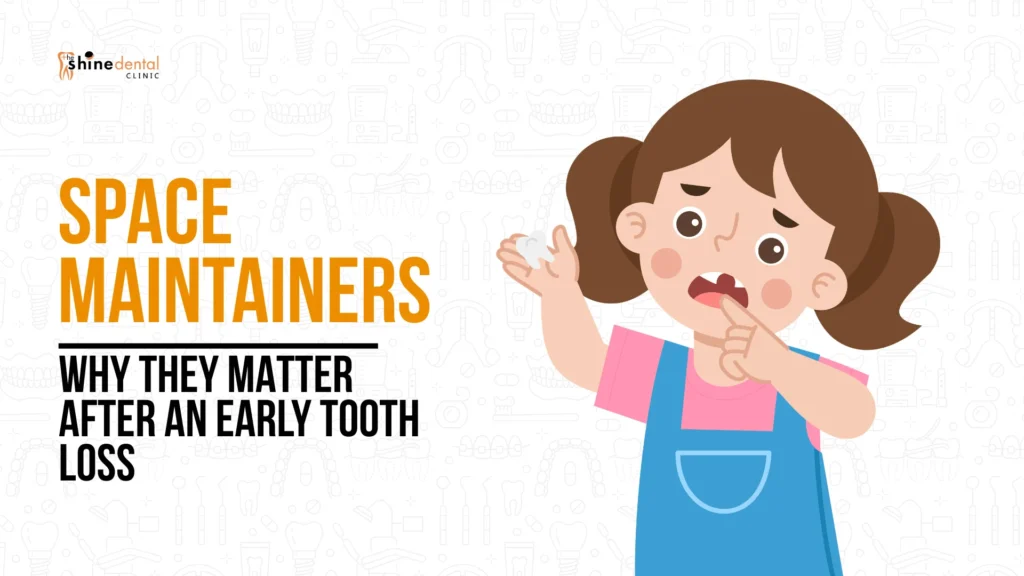
Quick answer: If your child loses a baby molar too early, from decay, trauma, or extraction, a space maintainers usually holds the space open until the permanent tooth is ready to come in. Skipping one is one of the more preventable causes of crowding and orthodontic problems later on.
A wiggly tooth falling out is a fun childhood milestone. But when a baby tooth is lost too soon, from decay, injury, or an early extraction, it isn’t always something to celebrate right away.
Baby teeth aren’t just placeholders for a cute, gap-toothed smile. They do real structural work. Each one holds open the exact amount of room a permanent tooth will need later.
When a tooth is lost too early, that carefully held space can start to close. Once it closes, getting it back can mean years of orthodontic work down the road.
This is where space maintainers come in. At The Shine Dental Clinic, we recommend them often. So parents deserve a clear, honest explanation: what they are, when they’re needed, and why skipping one can create bigger problems than the tooth loss itself.
What Is a Space Maintainer?
A space maintainer is a small, custom-made dental appliance. It holds open the gap left by a baby tooth that came out too early.
It works one of two ways. A fixed maintainer is cemented onto the neighboring teeth. A removable maintainer works more like a small retainer that can be taken in and out.
Either way, the job is simple: keep the neighboring teeth from drifting sideways into the empty space. That way, the permanent tooth underneath has a clear, correctly sized path to erupt into. The American Dental Association describes this same idea in its patient guidance: once a baby tooth is lost too early, neighboring teeth can shift into the gap unless something holds that space open.
Think of it as a placeholder in the truest sense: not decorative, but functional. Without one, the space doesn’t just wait patiently for the adult tooth. It starts to close within weeks to months.
Why Baby Teeth Matter More Than Parents Expect
It’s easy to assume baby teeth are temporary, so they don’t matter much. In reality, primary teeth do far more than help your child chew. They:
- Guide permanent teeth into position: each baby tooth sits directly above or beside the developing permanent tooth and helps guide its eruption path.
- Maintain arch length: the total space needed for all permanent teeth to fit without crowding.
- Support normal chewing and nutrition during a critical growth period.
- Help with clear speech development, particularly for front teeth.
- Preserve facial and jaw development, since the bite guides how the jaw grows.
The CDC’s Division of Oral Health makes a similar point in its guidance for parents. Healthy primary teeth are closely tied to a child’s nutrition, speech, and overall development, not just their appearance.
Dentists generally define premature loss as losing a baby tooth at least a year before its permanent replacement is due. The earlier this happens, the more time neighboring teeth have to shift, and the more space is ultimately lost.
Want to go deeper? Read our related post on why baby teeth matter.
What Happens If a Space Maintainer Isn’t Used?
This is the part parents are often surprised by. Without a space maintainer, one or more of the following commonly occurs:
- Neighboring teeth tip or drift into the empty space instead of staying upright.
- The opposing tooth over-erupts, growing down (or up) into the gap since there’s nothing to stop it.
- Arch length is lost, leaving too little room for the permanent tooth to erupt normally.
- The permanent tooth becomes impacted or erupts out of position: sideways, rotated, or blocked entirely.
- Crowding and bite misalignment develop, often requiring braces or other orthodontic treatment later.
None of this happens overnight. But a systematic review of clinical studies published via the National Institutes of Health found that space maintainers help prevent adjacent teeth from drifting. They also reduce the likelihood of needing more invasive orthodontic treatment later.
In other words, unmanaged space loss after early extraction is one of the more preventable causes of childhood crowding. A small appliance now is almost always simpler, faster, and cheaper than fixing a crowded bite later.
Already noticing early crowding in your child’s mouth? Our guide on signs your child may need braces walks through what to watch for.
Types of Space Maintainers
Not every child needs the same appliance. The right choice depends on which tooth was lost, how many teeth are affected, and your child’s age and cooperation level. Colgate’s overview of space maintainers for premature tooth loss confirms this same approach.
Band and Loop Maintainer
A stainless-steel band fits around the tooth next to the gap. A small wire loop extends across the space to touch the tooth on the other side. This is the most common option when a single primary molar is lost on one side of the jaw.
Distal Shoe Maintainer
This is used when a second primary molar is lost before the first permanent molar (the “6-year molar”) has erupted. A small metal extension sits just below the gum line to guide that permanent molar into place as it comes in. Because part of it sits under the gum, it needs closer monitoring.
Lingual Arch
When multiple teeth are missing on the lower jaw, especially on both sides, a lingual arch can help. It connects bands on the back molars with a wire that runs along the inside of the lower front teeth. This holds space on both sides at once, without needing separate appliances.
Removable Acrylic Maintainer
This option looks similar to a retainer. It’s typically used for older, more cooperative children, or when several back teeth are missing on both sides. It can be taken out for cleaning, but it needs consistent daily wear to work. That’s why it’s not always the first choice for younger children.
What About Front Teeth?
Losing a front (anterior) baby tooth early is common, especially after a fall. It usually doesn’t cause the same space-loss problems as losing a molar, since permanent front teeth tend to erupt on a similar timeline. That said, some children get a simple aesthetic appliance (sometimes called a flipper) to support speech and confidence until the adult tooth arrives. This is a decision we make case by case.
How Long Does a Child Need to Wear One?
A space maintainer stays in place until the permanent tooth is ready to erupt through the gum. That can take anywhere from several months to a few years, depending on how early the baby tooth was lost and which tooth is involved.
We check the appliance and take periodic X-rays, roughly every six months, to track the permanent tooth’s progress. That way, we remove the maintainer at the right time: not too early, and not too late.
Caring for a Space Maintainer at Home
A space maintainer only works if it stays intact and clean. A few simple habits go a long way:
- Brush gently around the appliance twice a day, paying extra attention to where it meets the gum line.
- Avoid sticky, chewy, or very hard foods: caramel, taffy, gum, ice, and hard candies are the most common culprits behind loosened or bent appliances.
- Discourage pushing on it with the tongue or fingers, which can bend or loosen fixed appliances over time.
- Keep up with regular dental visits so we can check that it’s still fitting properly and doing its job.
- Call us right away if it feels loose, broken, or falls out. A damaged maintainer that goes unnoticed defeats the purpose entirely.
Signs Your Child May Need a Space Maintainer
Not every lost tooth needs one, but you should ask your pediatric dentist about it if:
- A baby molar was lost due to deep decay, infection, or an extraction more than a year before its expected replacement.
- Your child lost a tooth from a fall or injury rather than natural exfoliation.
- More than one primary tooth is missing in the same area.
- X-rays show the permanent tooth still has meaningful time before it’s due to erupt.
If your child recently had, or may need, a tooth pulled, our guide on tooth extraction in children explains what to expect. It also covers how we plan for space maintenance afterward.
Still not sure? It’s always worth a quick check-up. A same-day evaluation is far easier than correcting a shifted bite two years later.
Why Families in Lalitpur and the Kathmandu Valley Choose The Shine Dental Clinic
Early tooth loss can feel stressful for parents, even when the fix is straightforward. That’s exactly why the experience around treatment matters as much as the treatment itself.
At The Shine Dental Clinic in Sanepa, Lalitpur, our women-led team specializes in gentle, child-first pediatric care. This includes space maintainer evaluation, fitting, and follow-up.
We take time to let your child settle in before any check-up. We explain each step in a way kids can understand, and use distraction techniques, music, and a calm environment to keep visits stress-free. This works for anxious children, children with autism or sensory sensitivities, and everyone in between.
We also work closely with expat and international families across the Kathmandu Valley. We offer English-speaking consultations and clear treatment planning every step of the way.
If your child has lost a tooth early, don’t wait to see if it “sorts itself out.” Explore our full range of pediatric dental services, learn more about our team, or get in touch to schedule an evaluation.
Catching space loss early is one of the simplest ways to protect your child’s smile for years to come.
Frequently Asked Questions
Is a space maintainer painful for my child?
No. Fitting a space maintainer is a straightforward, non-invasive procedure. Children may notice the appliance in their mouth for a day or two, but it shouldn’t cause pain once they adjust to it.
Can my child still eat and speak normally with a space maintainer?
Yes. Most children adapt within a few days. We simply recommend avoiding very sticky or hard foods that could loosen or damage the appliance.
Does losing a front tooth early always require a space maintainer?
Not usually. Front baby teeth are less likely to cause space-loss problems than molars, since the permanent front teeth tend to follow a similar eruption schedule. Your dentist will confirm based on an exam and, if needed, an X-ray.
What if the space maintainer falls out or breaks?
Contact us as soon as possible. A missing or damaged appliance stops protecting the space, and delays in refitting it can allow shifting to begin.
Is a space maintainer the same thing as a retainer?
Not quite. A retainer holds teeth in position after orthodontic treatment. A space maintainer prevents space loss before the permanent tooth has even erupted, usually years earlier in a child’s development.