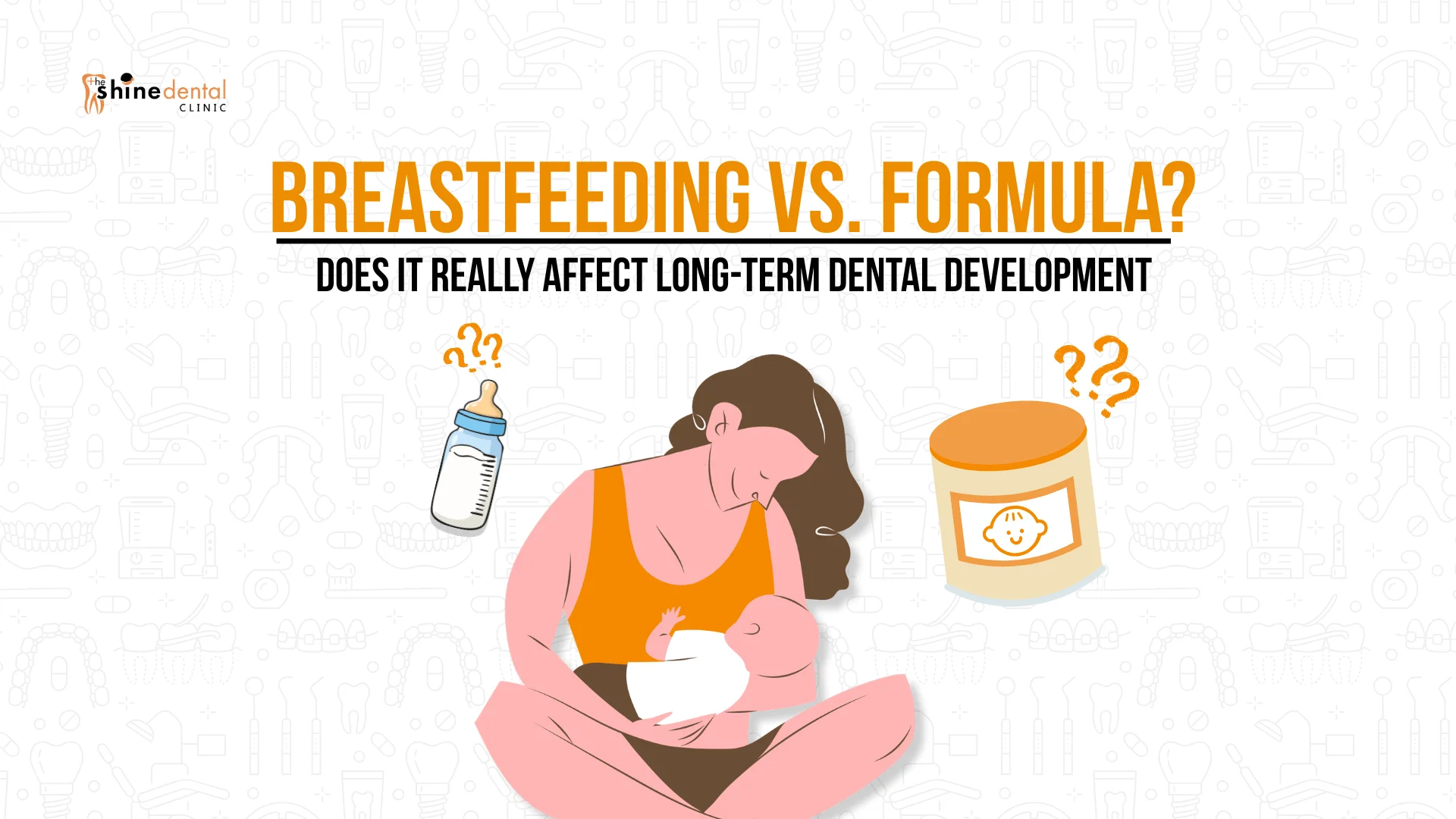
Quick answer: A little, but less than most parents fear, and less certainly than headlines suggest. Pooled studies find that breastfed children are less likely to have bite problems such as crossbite and open bite, but those studies are observational, often low quality, and mostly unadjusted for other factors like pacifier use. For cavities, breastfeeding up to 12 months has not been linked to extra risk, and the picture after 12 months is uncertain. Formula-fed babies do not have worse teeth by default. What matters more for teeth is how and when milk is given, what else goes in the bottle, how long bottles and pacifiers last, and whether teeth are cleaned. Whichever way you feed your baby, you are making a reasonable choice.
Few parenting topics carry as much emotion as feeding. If you breastfeed, you may worry about night feeds and cavities. If you use formula, you may worry that you have damaged your baby’s jaw. Neither worry is well supported by the research. This guide goes through what studies found, what they could not show, and what you can actually do.
First, the Bigger Picture
Dental effects are one small part of the feeding decision. The American Academy of Pediatrics (AAP) recommends exclusive breastfeeding for about the first six months if possible, and continuing alongside solid foods for as long as mother and baby wish. It also says that for families who cannot or choose not to breastfeed, infant formula is a safe, nutritious choice, and that there is no single “right” way to feed a baby.
In its guide on choosing between breastfeeding and bottle-feeding, the AAP adds that breastfeeding does not work for every family, and that is okay, and that medical reasons can make it difficult or unsafe. Neither AAP page discusses teeth. So nothing below should be read as a reason to feel guilty about how your baby is fed.
Does Feeding Method Affect Bite and Jaw Development?
This is the “long-term” part of the question, and it is where studies have found a pattern.
- A 2015 meta-analysis in Acta Paediatrica by Peres and colleagues pooled 41 studies covering 27,023 participants. It found lower odds of malocclusion, meaning teeth or jaws that do not fit together well, in children who were breastfed, breastfed exclusively, or breastfed for longer. The authors concluded that breastfeeding decreases the risk of malocclusion.
- A 2018 meta-analysis in the Journal of Human Lactation compared breastfeeding with bottle-feeding. It found that breastfeeding was associated with fewer malocclusions, and that the association grew with longer breastfeeding. Breastfeeding for six months or more was linked to lower odds of overjet, open bite, and posterior crossbite.
- A 2017 meta-analysis in Scientific Reports looked at breastfeeding duration and bite problems in baby and mixed teeth. Children who were never breastfed had higher odds of posterior crossbite than those breastfed for more than six months, although the confidence interval for the longer comparison was very wide.
Why This Is Not Proof
The same papers come with important warnings:
- Low quality. The authors of the 2018 meta-analysis say the studies were generally low quality, with statistical heterogeneity between them.
- Unadjusted. Most of the 2018 studies reported unadjusted measures, which means other factors were not controlled for. A baby who is bottle-fed may also be more likely to use a pacifier or suck a thumb for longer, and those habits affect the bite too. The 2015 abstract does not say how confounding was handled.
- Association, not cause. All three are observational studies of existing groups, not trials that assigned babies to a feeding method.
- Unclear long-term effect. The abstracts we could read do not tell us whether the differences last into the permanent teeth. Two of the reviews were about baby teeth, or baby and mixed teeth, so the long-term question stays open.
So a fair summary is that breastfeeding is associated with fewer bite problems, the reason is not settled, and the evidence cannot tell you whether your own child’s bite will be affected by how they were fed.
What Is Better Established
Our guide to thumb sucking, pacifiers and your child’s teeth explains that prolonged sucking habits can contribute to open bite and crossbite, and that the American Academy of Pediatric Dentistry (AAPD) recommends stopping non-nutritive sucking by 36 months. Our broader guide to childhood oral habits covers other habits that affect the bite. These are habits parents can influence, whichever way the baby was fed.
What About Cavities?
This is the question most parents of breastfed babies ask, and our post on whether breastfeeding can cause cavities answers it in detail. In brief, the research says:
- Up to 12 months, no added risk. A 2015 systematic review of 63 studies by Tham and colleagues, also in Acta Paediatrica, found that breastfeeding up to 12 months was not associated with increased cavity risk.
- After 12 months, less clear. The same review found higher cavity risk in children breastfed beyond 12 months, and higher still with night feeds. But the authors rated some estimates unreliable because the studies varied so much, and few controlled for sugar intake or oral hygiene. They suggest the extra risk may reflect factors that go along with prolonged breastfeeding, not the breast milk itself.
- Public Health England agrees the evidence is unsettled. Its guidance on breastfeeding and dental health links breastfeeding up to 12 months with lower decay risk, and says more research with careful control of confounding factors is needed for breastfeeding beyond 12 months.
- The dental policy is cautious. The AAPD’s policy on early childhood caries (last revised in 2016) says cavities may not arise from breast milk alone, but that breastfeeding combined with other carbohydrates is highly cariogenic in laboratory studies. It recommends limiting on-demand nursing once the first tooth erupts and other carbohydrates are introduced, while describing night nursing as associated with, but not consistently implicated in, cavities.
The practical middle ground, which our post also recommends, is not to stop breastfeeding for fear of cavities, but to clean teeth after the last feed when practical once teeth have erupted. Our guides to your baby’s first year of teeth and cleaning baby’s teeth properly show how.
What About Formula and Bottles?
Formula is not a dental problem in itself. The risk comes from how bottles are used. The AAPD’s early childhood caries policy:
- Recommends against sugar-sweetened drinks in a baby bottle or no-spill cup.
- Says night-time bottle feeding with juice increases cavity risk, while night-time bottles of milk are associated with cavities but not consistently implicated.
- Recommends against bottle use after 12 to 18 months.
Public Health England’s guidance adds that bottle-fed babies should be introduced to a free-flow cup from around six months, that bottle feeding should be discouraged from 12 months, and that only breast milk, formula, or cooled boiled water should go in a bottle, with no sugar added.
On safe feeding position, the AAP’s bottle-feeding basics says to support the baby semi-upright and to try not to bottle-feed a baby who is lying on their back, because of choking and the risk of middle ear infections. That page was last updated in 2012 and does not discuss teeth, but it is a useful reason to avoid feeding a baby to sleep in a bottle.
A Quick Guide
| Your situation | What the evidence suggests |
|---|---|
| Breastfeeding under 12 months | No dental reason to change anything. Wipe gums, and brush when teeth appear |
| Breastfeeding beyond 12 months, with night feeds | Evidence is uncertain. Clean teeth after the last feed when practical, and talk to your dentist. There is no need to stop |
| Formula or bottle feeding | Keep to milk, formula, or water in the bottle, no sugar. Move to a cup from about six months, and finish bottles by 12 to 18 months |
| Pacifier or thumb sucking | Plan to stop by about 36 months, per AAPD guidance in our post |
| Worried about the bite | See a dentist by the first birthday, and see our guide on early signs of braces needs |
If breastfeeding is difficult or painful, or your baby struggles to latch, our guide to tongue-tie and lip-tie in babies explains what those terms mean and when a dentist can help.
When to See a Dentist
You do not need to wait for a problem. Our first dental visit guide recommends a visit by the first birthday or within six months of the first tooth. A dentist can check how teeth are coming in, talk through your feeding and bedtime routine without judgment, and flag anything about the bite worth watching.
FAQ
Does breastfeeding really protect against crooked teeth?
Studies find that breastfed children are less likely to have bite problems such as crossbite and open bite, but the studies are observational and often low quality, and they do not control well for factors like pacifier use. It is a modest association, not a guarantee.
Will formula feeding damage my baby’s jaw or teeth?
There is no evidence that formula itself damages teeth. Bottle habits matter, for example sweet drinks in the bottle, bottles at night, and keeping a bottle past 12 to 18 months. The AAP says formula is a safe, nutritious choice.
Can I keep breastfeeding past 12 months?
Yes. The AAP supports breastfeeding for two years or beyond alongside solid foods. Research on cavities beyond 12 months is unsettled, so the sensible step is to clean your child’s teeth, especially after the last feed of the day, and to see a dentist.
Do I need to stop night feeds once teeth come in?
Not necessarily. The AAPD says night nursing is associated with cavities but not consistently implicated, and its policy suggests limiting on-demand nursing once teeth erupt and other carbohydrates are introduced. Talk with your dentist or pediatrician about what works for your family.
Does feeding method matter more than pacifier or thumb sucking?
For the bite, prolonged sucking habits are a better-understood influence than feeding method, and they are something you can change. See our guide to thumb sucking and pacifiers.
The Bottom Line
Feeding method has a modest, uncertain association with bite development and little direct effect on cavities. What matters for your child’s teeth is the daily detail: no sugar or juice in bottles, cleaning teeth, finishing bottles and pacifiers on time, and an early dental visit. Feed your baby in the way that works for your family, and let the dentist help with the rest.
Have questions about your baby’s feeding routine and teeth? Book a first visit with The Shine Dental Clinic in Lalitpur, where we can look at your child’s teeth and bite together.