

When your baby starts teething, it’s natural to look for ways to ease their discomfort as quickly and safely as possible. In the search for relief, many parents come across amber teething necklaces which are often marketed as a natural, chemical-free solution that can reduce pain without the need for medication. At first glance, they may seem like an easy and gentle option.
These necklaces have gained popularity through word-of-mouth, social media, and parenting communities, where some claim they have helped soothe their baby’s teething symptoms. However, alongside these claims, there are growing concerns from healthcare professionals about their safety and effectiveness.
This leads to an important question: Do amber teething necklaces really work, and are they safe for your baby? Understanding the facts behind these products can help you make informed decisions and avoid unnecessary risks during an already sensitive stage of your child’s development.
What Are Amber Teething Necklaces?
Amber teething necklaces are made from Baltic amber, a type of fossilized tree resin that has been used for centuries in jewelry and traditional remedies. These necklaces are designed to be worn around a baby’s neck or wrist, with the belief that they can help reduce teething pain naturally.
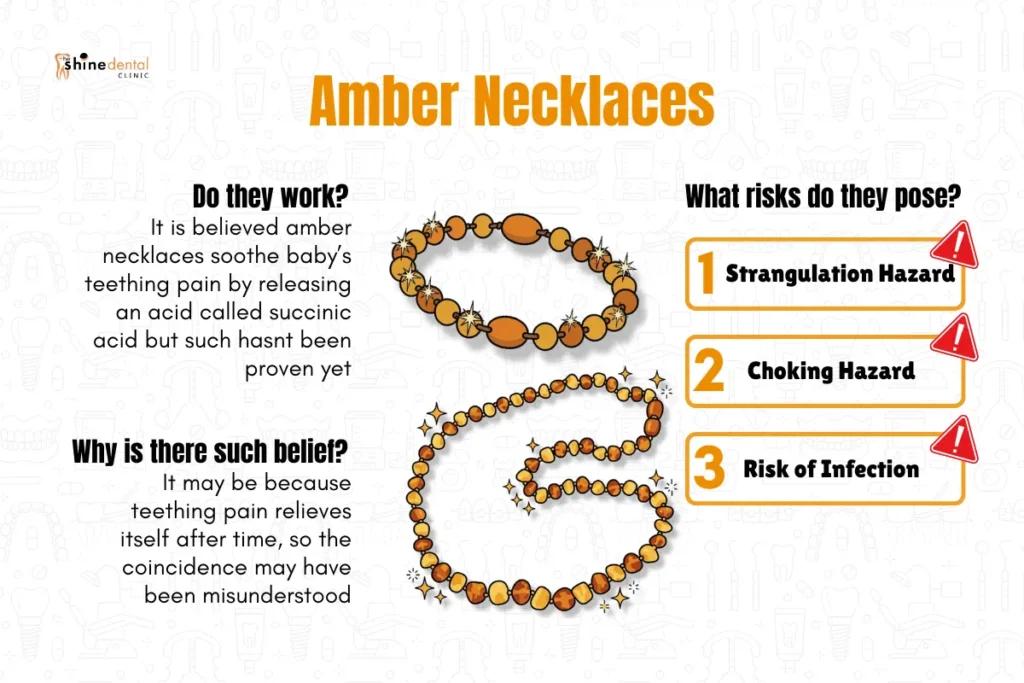
The idea behind these necklaces is that when amber comes into contact with the warmth of the skin, it releases a substance called succinic acid. This compound is claimed to have anti-inflammatory and pain-relieving properties, which supposedly helps soothe sore gums during teething.
Because of this explanation, many parents are drawn to amber necklaces as a “natural alternative” to other forms of relief.
Despite their popularity, there is no reliable scientific evidence that supports the effectiveness of amber teething necklaces in relieving teething pain. However, medical sources like the NHS note that teething discomfort is temporary and typically manageable with simple, safe methods, without the need for unproven products.
While some parents report positive experiences, these are considered anecdotal, meaning they are based on personal observation rather than controlled studies. In many cases, improvements in a baby’s mood or comfort may simply be due to the natural progression of teething, which often comes and goes in phases. If you’re trying to work out what’s typical for your baby’s age and stage, our guide on signs of teething in babies, timeline, symptoms, and when to seek extra care breaks this down in more detail.
According to guidance from HealthyChildren.org, teething symptoms usually come and go in phases, which can create the impression that a product is working when symptoms would have improved on their own.
From a medical perspective:
There is no clear proof that succinic acid is released in a way that can affect the body through the skin. Even if it were released, there is no evidence showing it would provide meaningful pain relief. Teething discomfort typically resolves on its own within a few days, which can create the illusion that the necklace is working. To understand how long that natural resolution usually takes, see our stage-by-stage teething timeline for parents.
Because of this, most healthcare professionals agree that amber teething necklaces should not be relied upon as an effective solution for teething discomfort.
Risks of Amber Teething Necklaces
While the lack of proven benefits is important, the potential risks associated with amber teething necklaces are an even greater concern. These risks can be serious and, in some cases, life-threatening.
Choking Hazard
One of the main risks is the possibility of the necklace breaking. If the string holding the beads snaps, small amber beads can scatter and become easily accessible to your baby.
Since babies naturally explore objects by putting them in their mouths, there is a real risk that they may swallow or choke on these small pieces. Even a single bead can block the airway, making this a serious safety concern.
Safety agencies such as the Centers for Disease Control and Prevention emphasize the importance of avoiding products that can break into small, swallowable parts.
Strangulation Risk
Wearing any type of necklace around a baby’s neck poses a risk of strangulation. Babies move frequently, roll during sleep, and may tug or pull on objects around them. This increases the chance that the necklace could become caught on something or tighten around the neck.
This risk is especially concerning during sleep or unsupervised moments, when parents may not be able to respond immediately.
According to the American Academy of Pediatrics, these risks are significant and should not be ignored.
Lack of Regulation
Another issue is that amber teething necklaces are not always subject to strict safety regulations. This means the quality, durability, and safety standards can vary significantly between products.
Some necklaces may use weaker strings, poorly secured clasps, or lower-quality materials, increasing the likelihood of breakage or failure. Without consistent regulation, it becomes difficult for parents to ensure they are purchasing a safe product. The U.S. Food and Drug Administration has issued its own formal warning on amber teething jewelry specifically, citing reports of choking and strangulation tied to these products.
Why Experts Advise Against Them
Due to the combination of unproven benefits and real safety risks, most healthcare professionals strongly advise against using amber teething necklaces.
The American Academy of Pediatrics has specifically warned that amber necklaces pose choking and strangulation hazards and should not be used for teething relief.
Pediatricians and dental experts emphasize that the risks of choking and strangulation outweigh any potential benefits, there is no medical evidence supporting their effectiveness, and safer, well-tested alternatives are available.
Organizations focused on child safety consistently recommend avoiding products that pose unnecessary risks, especially when safer options exist. It’s also worth knowing the difference between ordinary teething discomfort and symptoms that need medical attention; our article on teething and fever in babies, what’s normal and what’s not covers exactly that distinction.
Safer Alternatives for Teething Relief
Instead of relying on products with questionable safety, there are several safe and effective methods that can help soothe your baby during teething.
Guidance from the NHS supports simple and safe approaches such as:
Chilled Teething Toys
Offering a slightly chilled (not frozen) teething toy can help reduce inflammation and provide soothing relief. The cool temperature gently numbs the gums, making your baby feel more comfortable. For help choosing the right one, take a look at our roundup of the best teething toys for babies and safe picks every parent should know.
Gentle Gum Massage
Using clean hands, you can gently rub your baby’s gums to relieve pressure. This simple method can be surprisingly effective and provides immediate comfort.
Safe, Proven Relief Methods
Sticking to well-known and recommended approaches ensures your baby’s safety. These include maintaining routines, offering comfort, and using products specifically designed for teething. For a complete breakdown of what works, what to avoid, and when to see a dentist, read our guide on safe teething pain relief: what works, what to avoid, and expert tips for parents.
Why “Natural” Doesn’t Always Mean Safe
One reason amber teething necklaces remain popular is the perception that “natural” products are automatically safer. While this can be true in some cases, it’s not always accurate especially when it comes to babies.
A product being natural does not guarantee that it is safe to use, free from risks, or effective in providing relief.
In fact, some natural products can carry risks simply because they are not designed with modern safety standards in mind. This is why it’s important to evaluate products based on evidence and safety guidelines rather than marketing claims.
How to Make Safe Choices as a Parent
When choosing teething solutions, it’s helpful to focus on a few key principles: prioritize safety over convenience or trends, choose products that are tested and recommended by professionals, avoid items that pose choking or strangulation risks, and observe your baby’s symptoms and respond accordingly.
Making informed choices doesn’t mean avoiding all solutions, it simply means selecting the ones that are both safe and effective.
Conclusion
Amber teething necklaces may appear to be a simple and natural solution, but when examined closely, they do not offer proven benefits and come with significant safety risks. The lack of scientific evidence, combined with the potential for choking and strangulation, makes them a risky choice for soothing teething discomfort.
Understanding the reality behind amber teething necklaces allows parents to make safer, more confident decisions. Instead of relying on unproven products, choosing well-established, risk-free methods ensures your baby remains comfortable and protected during this important stage.
Teething can be challenging, but with the right approach and safe solutions, it becomes much easier to manage, giving both you and your baby greater peace of mind. Visit The Shine Dental Clinic to smoothen your journey.